I spent the better part of my thirties examining my past to better understand my present.
Now in my forties, I feel like I’ve got a solid understanding of how I came to be who I am.
I understand that while I will never be able to fill the gaps for that lonely, lost little girl of my past, I sure can provide my own girls with a solid foundation.
And instead of wallowing in what happened, I can forgive myself for my missteps, buckle up my shoes and keep walking, eyes forward.
My childhood friends and I always mimicked my mom’s “You have a choice, Lauren.” speech. But my mom gets the final laugh because, she was right!
There are always going to be people we’d rather not be around or challenging, unavoidable life events.
We can’t choose those people or those events but we can choose how we handle them.
It’s how we respond that matters.
I have quite a few friends enduring some major life changes this holiday season- deaths of loved ones, divorce and general heartache.
To them and to all of you reading, I reach out my hand to hold yours and to remind you that in this holy season, you can also put those hands together in prayer to ask for God’s help.
You’re not alone.
We never are.
That’s one choice we can’t make.
Wishing you love, peace and joy this holiday season.
Lately, I’ve started to visualize my life as a river.
She’s a real beaut.
Surrounded by tall trees and mountains. She curves through forests, banked by shady trees; winding through cities, carrying on as rapids to more peaceful pastures.
My river began as a stream and has gained confidence and power along the way.
There have been moments when my river stalled. She was curious, exploring a side cove.
Sometimes, she got stuck in a whirlpool.
Round-and-round she went until she forgot not only where she came from but also where she was going.
Finally, a particularly dreadful downpour left her overflowing back to her main stream whereupon she realized, with great relief, that the whirlpool wasn’t her final destination.
The older I get, the more I learn just how important they are.
Setting them, adjusting as needed, and keeping them.
They are important for all relationships, personal and professional.
Marriage, friendships, coworkers and family.
I’ve come to realize I feel most out-of-control when I’ve either failed to set a boundary or neglected to enforce it.
And I had that come-to-Jesus moment just yesterday.
One of my daughter’s spiraling separation anxiety has left me feeling suffocated. Aside from school, she will go very few places without me present- the entire time. Which is why we end up hosting most of her friends at our house and why I stay for her after-school activities.
It’s not her fault. We are seeking multiple avenues of professional help. But it’s exhausting. I’m sure for her, too.
I birthed her and I will stand by her, through thick and thin. She will know that when things get tough, I am walking alongside her through the muck until she is strong enough to wave goodbye and walk alone.
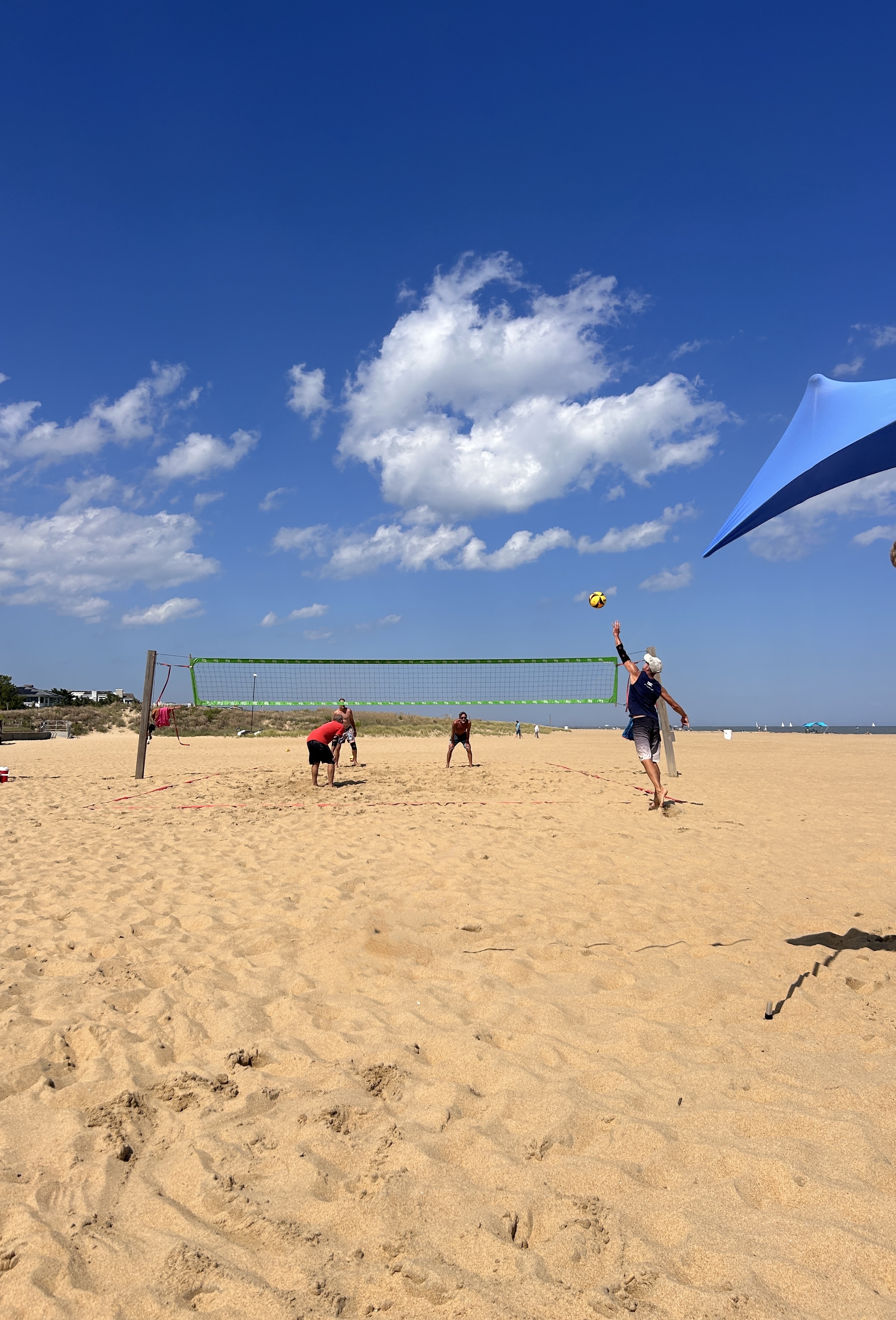
But yesterday, I was upset that I was going to miss my husband’s volleyball tournament so that I could stay for my daughter’s weekly extracurricular. And in my frustration and resentment, I realized that her anxiety was now directly affecting MY life, MY marriage. I was failing to keep my boundary.
So, I explained- you can go to your extracurricular alone or you can miss it and come with me because today, I choose me. I choose my husband. I choose our marriage, which we’ve always stressed comes absolutely first in this family. Without the strength of that bond, the rest collapses.
He didn’t know I had changed plans and cracked a smile as we walked onto the beach.
Was I the only one with tears streaming down my face while watching Inside Out 2 in the theater this morning?
I’m not sure but sitting next to my four daughters, this movie really hit home- particularly in reference to our 12 year-old.
Those who know me personally know how attentive I’ve always been of our daughters’ feelings. As a child who often felt misunderstood, I know how important it is for my girls’ feelings to be validated, seen and explored, instead of ignored.
Spoiler alert: the climax of the movie occurs when the emotion Joy realizes that she can no longer simply dismiss undesirable memories and power forward through main character Riley’s puberty ignorant of the arrival of new emotions anxiety, embarrassment, ennui and envy. The lesson that struck deep in my heart was that there was no turning back to the way things were before. Instead, Joy recognizes her need to include the new emotions in order for Riley to feel secure with her true self. It’s a hard pill to swallow- that we can’t just keep acting like everything is fine and BE fine. That when we try to fight anxiety with denial, it only grows. We must learn to live with, around and through it.
Watching my child struggle with growing up has broken my heart into tiny little pieces. I want to fix it for her; the embarrassment the rejection, the shame she feels. And like Joy, I can’t. I watch helplessly as she struggles, knowing that there’s no other way than through.
And yet, the overwhelming emotion I left that theater with was pure and true gratitude. As hard and ugly as witnessing Aurora’s journey to adulthood is, it’s also such an incredible privilege. I have been given a gift- this opportunity to empower and encourage my child. I walked away with more empathy than ever for my daughter and the desire to hug her as long as she would allow. Forever and ever. Inside out.
I wish I could but I never will forget the supreme loneliness I felt as a child.
And I suppose that is why, as an adult, I feel so committed to seeing children.
Physical presence is not enough.
Neither is saying “I care.”
It’s action.
Before I took the pills that landed me in the hospital, before I stood on the edge of the balcony threatening to jump, I cut myself as a way to ease the pain.
I was 12 years old.
So, when my daughter exhibits signs of distress,
I take her seriously.
When minimal interventions (intentional time together, changes to routine, etc.) fail to work, I take action: therapy, medication.
“If there’s one thing we can always count on,” I explain to my daughter, “it’s change.”
No matter how much we wish we could freeze time or return to the way things were before, change is inevitable.
We may not be able to force the way things change, but we are able to control how we respond to it.
Entering her first year of middle school, my eldest daughter is enduring a lot of change that frankly, she’s not a huge fan of.
Riding the school bus for the first time, switching classes that are much larger than elementary and the loss of the familiarity of her previous school.
Change is hard, for better or worse.
In these beginning moments of great change, her emotions are running hot and cold. The smallest of problems are monumental. It reminds me of a conversation I had with her when she was just four years old.
I had just given birth to our third daughter, resulting in me leaving my two and four year old to play on their own while I nursed their baby sister to sleep.
They would barge in with battles over a toy or to ask if they could have some pretzels, waking the baby from her near slumber.
It was time for an intervention.
I sat them both down and discussed the difference between “Big Problems” and “Little Problems”. I actually recorded it so that I could share it with my friends and I’m so glad I did because there’s a precious moment when the lightbulb goes off in my four year-old’s head. She got it.
Big problems are when you are bleeding, someone is at the door or there’s a bonafide emergency. Little problems are snack requests or arguments over toys.
The same still holds true. Sometimes in moments of stress and vulnerability, even the smallest problems seem overwhelming. But if we take a moment to stop and really think, we realize they aren’t so life-threatening after all.
Recognizing the difference is the first step.
Adapting is the next.
Forgotten materials and missed assignments are challenging, but fixable.
Changing schools is hard but not insurmountable.
The sooner we anticipate and roll with change, the less anxious we will feel.
“There’s another thing you can count on.”I whisper to her as I tuck her into bed.








 New Leaf Parenting